
How to frame art prints (and make a £20 print look like £200)

To frame an art print, pick a frame one size bigger than the print and use a mount (the card border) to fill the gap: an A4 print in a 30 x 40cm frame, or an A3 print in a 40 x 50cm frame. Choose an acid-free mount, glass or acrylic glazing, and a simple black, white or wood frame.
I'm going to tell you the single biggest secret in art: the frame does half the work. A £20 print in a good frame with a mount looks like it came from a Mayfair gallery. The same print stuck to the wall with tape looks like a student flat. (Nothing wrong with student flats. I wrote a whole post on art for student flats.)
Here's how to frame prints properly, without spending a fortune.
The parts of a frame, in plain English
- Frame: the outside edge. Wood, metal or plastic.
- Glazing: the clear front. Glass or acrylic.
- Mount: the card border between print and frame. Also called a mat.
- Backing board: holds everything in place at the back.
The mount is the bit people skip, and it's the bit that makes framing look expensive.
What size frame for an A4 or A3 print?
| Frame with mount | Frame without mount | |
|---|---|---|
| A5 | A4 or 20 x 25cm | A5 |
| A4 | 30 x 40cm | A4 |
| A3 | 40 x 50cm | A3 |
| A2 | 50 x 70cm | A2 |
Ready-made frames often come with a mount already cut for a standard print size. Check the mount aperture (the window in the middle). It should be slightly smaller than the print so it overlaps the edges by a few millimetres.
My A4 prints have the artwork at about A5 with a white border on A4 paper, so they look great in an A4 frame without a mount, or in a bigger frame with a mount cut to show the border.
View pieceI Have Champagne Taste
 View piece
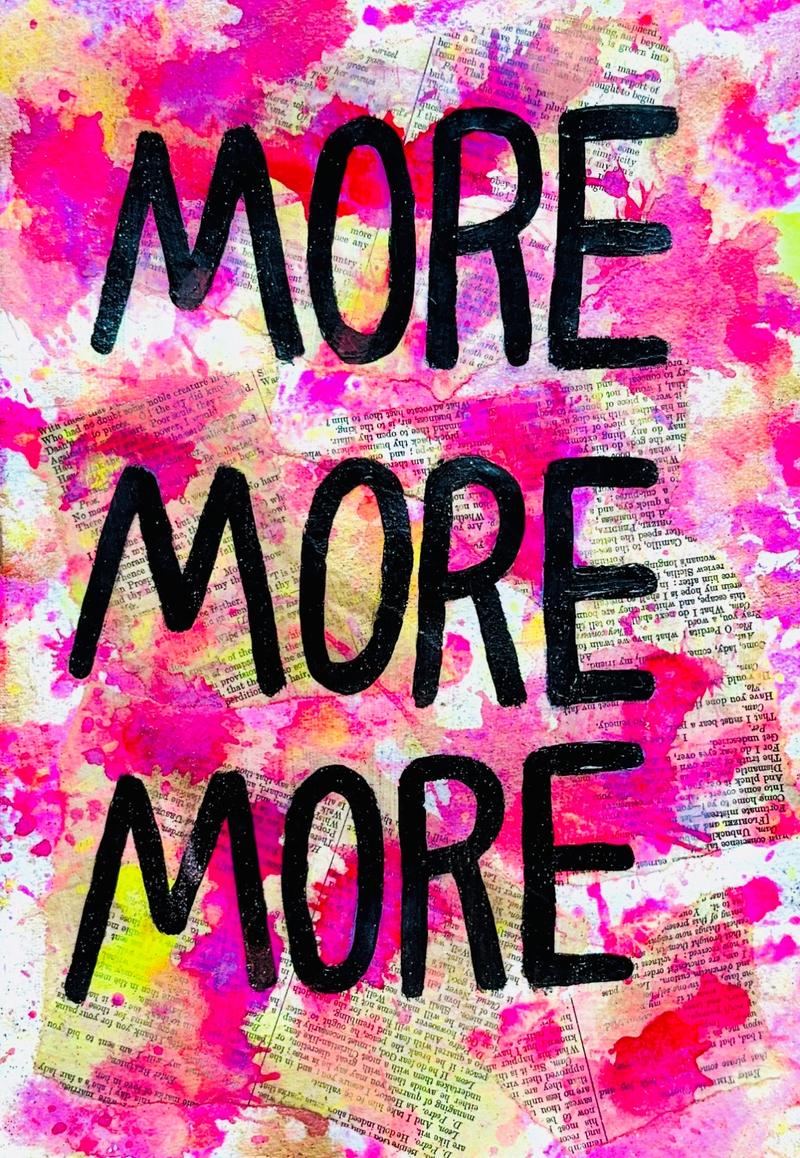
More More More
 View piece
Women Are Not Afraid
 View piece
I Am Luxury
Glass or acrylic?
- Glass: clearer, harder to scratch, heavier, breaks if dropped.
- Acrylic (perspex): lighter, shatterproof, better for kids' rooms, big frames and posting. Scratches more easily, so clean it with a soft cloth.
- UV-protective glazing: worth it for originals or anything near a sunny window.
- Anti-reflective glazing: pricier, but brilliant opposite windows.
For bathrooms and kitchens, always frame behind glazing. Steam and splashes are not kind to paper.
Choosing a frame colour
- Black: makes bright colours pop. My go-to for pop art.
- White: fresh, gallery-like, lovely on coloured walls.
- Natural oak: warm, works in almost every home.
- Gold or brass: a bit glam, perfect for fashion prints and the champagne series.
- Neon: bold, which is why my big originals go in neon acrylic frames.
Don't stress about matching every frame. A gallery wall can mix frames as long as the art has something in common.
DIY or a professional framer?
DIY with ready-made frames is fine for prints. It's cheap and quick, and the high street is full of decent frames with mounts included.
A professional framer is worth it for originals, odd sizes, anything valuable or sentimental, and box frames for pieces with torn edges. They'll use acid-free materials and fix it properly.
How to frame a print at home, step by step
- Wash your hands. Fingerprints on prints are forever.
- Clean both sides of the glazing and let it dry.
- Lay the frame face down on a towel.
- Put in the glazing, then the mount, then the print face down.
- Line it up by flipping it over and checking before you close it.
- Add the backing board and close the clips.
- Check for dust. There will be dust. There is always dust. Repeat step 4.
Never glue or tape a print to the mount with household tape. If you need to fix it, use acid-free hinging tape at the top only, so the paper can move.
Should originals be framed differently?
Yes. Originals on paper deserve acid-free mounts, UV glazing and a frame that doesn't press the glazing against the paint. My originals are painted on antique book pages, some with raw torn edges, and they look beautiful "floated" in a box frame so you can see the edges. Read more in antique book page art.
Where to hang a framed print
Centre at about 145 to 150cm from the floor, 15 to 25cm above furniture. More in what size art print for a living room and, for renters, how to hang art without damaging walls.
Framing questions
An A4 frame without a mount, or a 30 x 40cm frame with a mount cut for A4.
An A3 frame without a mount, or a 40 x 50cm frame with a mount cut for A3.
Usually yes. A mount gives the print space, protects it from touching the glazing and makes it look more expensive.
Glass is clearer and harder to scratch. Acrylic is lighter and shatterproof, better for large frames, children's rooms and posting.

Pop artist at Jubilee Market Hall, Covent Garden, since 2021. Hand-paints bold, funny slogans on antique book pages. More about Luis.
More from the blog.

Art prints for your first home: a room-by-room starter kit
Just got the keys? Covent Garden artist Luis Alvarez on art prints for your first home: what to buy first, room by room, on a first-home budget. From £20.

How to choose art for your home (without overthinking it)
How to choose art for your home without overthinking it. London artist Luis Alvarez on picking art by room, colour, size and gut feeling, with real examples.

What size art print for a living room? The simple rules
What size art print do you need for your living room? Simple rules, a size table (A4, A3, A2) and how to make small prints fill a big wall, from a London artist.